Ah the freshness of rebirth in Spring weather and she dreams of blossoms in April and Stanley Park in Vancouver.
budding promise on the Pacific coast cherry trees sway
Yet east of the country in Québec weather has its highs and lows…white as it may be, fluffy and unique in each detail, these snowflakes but still, SNOW is a four letter word!
She took the day off from work …just because. Relaxing on her comfy couch, reading her book, she looks over at her friend, sitting leisurely on her throne.
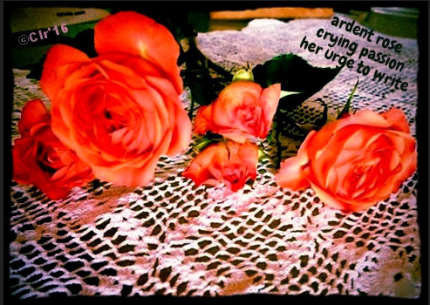
Her son and daughter-in-law arrived March 20th, for a belated birthday brunch with an armful of assorted flowers. She was taken by surprise, expecting to eat out but never had she imagined such an array of beauty. Words of affection on the gift card warmed her heart. Several kinds of daisies with exuberant colours brought life to her living room and then her eyes set on those roses…
(Troiku) ardent rose crying devotion her urge to write
ardent rose
breath of new life
filled with passion
crying devotion
first day of spring
ties renewed
her urge to write
a therapeutic process
soothes the soul
Every day come spring, summer and fall, she rides the elevator to the top floor, turns the corner and climbs the stairs to the roof. The wind blows from le Mont Royale; she sits facing west, inhaling the Artist’s performance.
final vernissage
rich magenta hues at dusk
until tomorrow
Can never seem to get enough of you, oh luna plena. I look up at you and know we have a clandestine relationship, just you and me. A few days each month I see you lest the clouds hide you with greed, keeping us apart but still, I know. Every fibre in my body feels you, knows you are there near me taunting me…sometimes, our love breeds pain…my head throbs but not my heart. My heart bleeds wistfully for you.
I waited for both children to be in school before making some life changes. I started to volunteer making friendship visits to isolated or terminally ill residents in my community; there was one eighty-eight year old widow, Mrs.Darby who used to teach at my children’s school. She was frail suffering from Emphysema and lonely. One day she called me to get her a loaf of bread. When I arrived at her home with the bread, her next door neighbour was just leaving her home having also dropped off a litre of milk. I chuckled at how cunning she was to insure a visit.
She was a delightful lady. We would spend hours talking about how she used to personally sew her Grade 2 students’ outfits for concerts; one evening we spent hours looking over her Christmas baking recipes. Hearing her talk about her years teaching gave me the idea to invite her to my children’s Christmas recital. There was a snowstorm that day, but we still managed to get to the school. I watched her face glow when she saw the children performing on stage. After the assembly, it was such a treat to see so parents and even some grandparents walk up to greet their former Grade 2 teacher. It was priceless to see the joy on Mrs. Darby’s face…
happenstance
together on the same path
for a season,
a last farewell gift
before finding the light
Our host has presented an interesting prompt as we discuss episode 7: The Tibetan Book of Living and Dying Insight 6 balance isn’t always necessary and his introduction on this subject speaks to me as well as his haiku.
Working on a youth line, listening to youths in crisis every evening, I have to find some balance in my life so I do not live with stories of abuse and sadness. Reading was my way to escape for many years until I rediscovered writing. I am able to defuse pent up emotions and other times rediscover the beauty around me and write about it in a haibun, haiku, troiku or tanka. In other words, waka has added the beauty of nature dripping in my whole being with sights, sounds and scents.
I take away so much strength from the power of the firmament…the blues, the greys, the curves of clouds as well as sunsets I often view on my break on the rooftop at work.
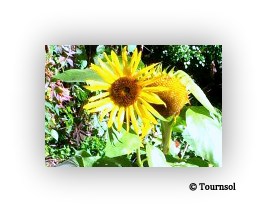
Our host has written a haiku about early dawn which is a time I rarely see at the start of my day recently due to my shift change in the past few years but I do remember that spiritual feeling The haiku includes a sunflower which is my nom de plume in French, Tournesol, so his haiku truly speaks to me. …here is my response to his haiku I have composed in a Troiku which is a haiku form created by our host, Chèvrefeuille.
in the light of dawn sunflowers reach to the blue sky praising their Creator
Rinpoche sees life as a bardo (a kind of transition station) and that’s not a such bad idea in my opinion. It shows us that our consciousness has senses, lives in a world, observes, starts relationships, living life. Rinpoche says: “Life is to discover the goodness of life, an exercise to realize that life is good and that also means … accepting dead as part of our life.”
Look at yourself with compassion from the depth of your consciousness, your soul. It’s a peaceful thought to know that our daily personality has a deeper Inner Self to whom we can listen always. Our Inner Self is our tower of strength. A lovely Inner Voice, that whispers: “Yes you are out of balance, but don’t worry you will regain your balance. You need this difficult time to grow and become stronger and more balanced. So don’t worry, don’t be afraid, I am there, I am with you. I travel with you”. Isn’t that a reassured idea? Isn’t that the reason to live your life to the fullest?
My response
This is so true. Whenever I find myself out of balance, my body breaks down and I need to take time off and rest. Often these were times I discovered the value of true friends who were there to take walks in nature, share a home cooked meal or just listen and be present with me. I also love long moments alone…










 Tournesol dans un Jardin