tears of joy (haibun)

Written for Carpe Diem Haiku Kai Prompt:  “tears falling”

Grief followed her like a doting puppy; days, weeks, months of moments tears just soaked her face; never a moment’s notice, tears of grief are spontaneous and sneaky. She knew this; expected this and accepted the sudden burst of tears.

Last week, marked a milestone in her career and colleagues and friends were most generous with comments and well wishes. At the end of her shift in the late evening, a colleague working the night shift rushed to her to deliver a beautiful bouquet of fresh cut flowers.

sudden burst
heart bathed in pure love
tears of joy

(c) Tournesol ’15

taunting falls (tanka)

File:Princess louise falls.jpg
http://www.fallingbrook.com/history/falls.htm

cascades d’eau
inondés de souvenirs
d’un temps lointain
même l’eau n’apaise plus
ces chutes moqueurs

***

waterfalls
flooded with memories
a time long ago
even water does not soothe
those mocking falls

(c) Tournesol ’15

Old straw hat (haibun)

The morning after la fête de la St-Jean, waves roll debris on wet sand;  seagulls screech for revellers’ leftoversr. Walking on wet sand, she limps to a bench and watches the sun break through the clouds, remembering dancing around le feu de la St-Jean with him.

straw hat shields
greeting new dawn
weathered skin

(c) Tournesol’15

Carpe Diem #773 Mugiwara boushi (straw hat)

when Haiku and I first met (haibun)

I know I am too late for this prompt as I have been off the blogosphere lately, yet, I enjoyed a post written by Georgia at Bastet who completed this prompt. Now this blog at Bastetandsekhmet is a great blog to visit. This is one blog I never tire reading the depth of many of her poems, the humour in her choka and the authenticity in her friendship.

Our host, Chèvrefeuille, and mentor here posted a narrative along with a breathtaking series of haiku on honeysuckles (which is chèvrefeuille in French, by the way) entitled “How it all started” In response to this post, Georgia wrote about her love of haiku and tanka, which inspired me to write this.

I was first drawn to haiku to post with a photo I had taken of nature and sunsets. I found the image spoke one language and the haiku whispered in the language of the unconscious. Looking back to my very first haiku or haiga (haiku written within an image) I was surprised to see my first was in October 2013; Tanka was a form I noticed several poets used to make a statement…brief, to the point and usually quite poignant…I am trying to master this better but am still devoted to improving my haiku.
shortcut which is through a thicket of odd trees, bushes and wild flowers. This moment truly blessed me minutes before I started my shift.
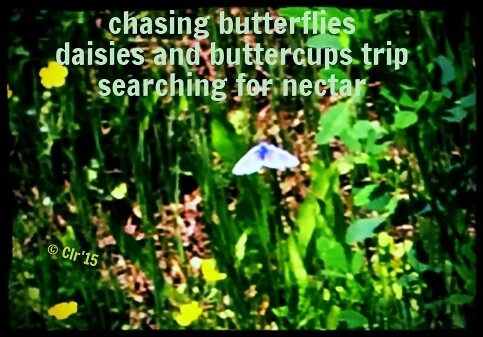
chasing butterflies

chasing butterflies
daisies and buttercups trip
searching for nectar

I am blessed with a family or classroom with dedicated, talented and so diverse in writing this form. I think I started a good time in my personal life as well as I process day to day life, I grow in the essence of their creative genius.

I love sunrise and sunsets but usually I get to bed so late it is just pre-dawn, so I hear the first chirping of birds. I have chased sunsets moreso in the past twenty years.

There is not one season that we cannot find moments to capture a moment, hold it long enough to write three lines. Yet, I have to say that I am not only inspired but excited during springtime
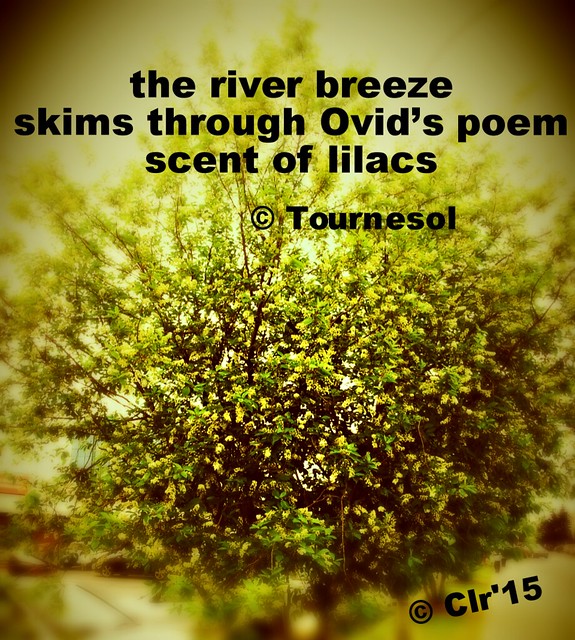
20140522_131423_Android

The river breeze
skims through Ovid’s poem
scent of lilacs

I don’t know if it is because I am a water sigh or that I was raised by a river but I do love writing about water…it is my place of solace as much as sunsets soothe me, water replenishes the soul.

This was written by the river where I grew up:

TABLET - yamaska june (4) - Copy

By the river
painful secrets trickle
water filled with tears

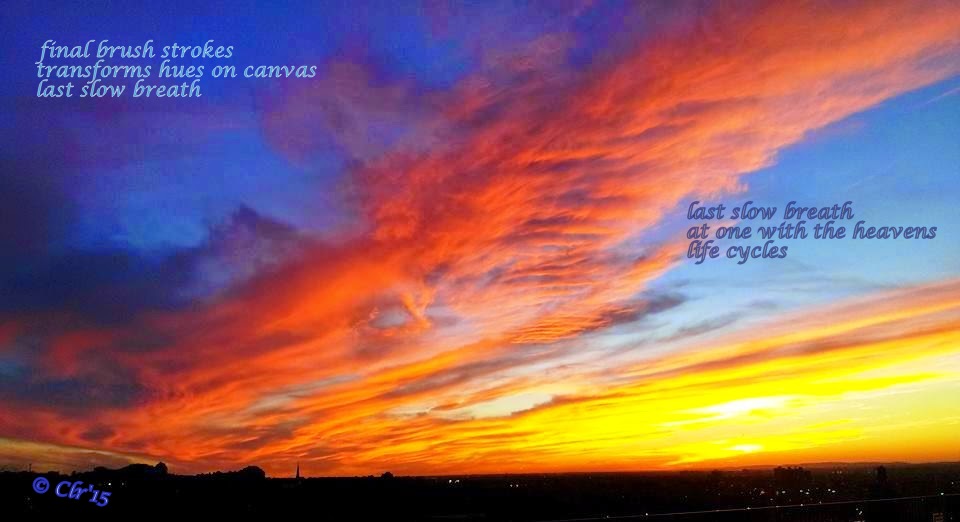
This was an excellent exercise in reviewing old haiku…I had not realized how many I had accumulated in the past year. I will end with one of many I have written on sunsets. This photo was taken on the rooftop at work in Montreal.

sunset double haiga

Final brush strokes
transforms hues on canvas
last slow breath

last slow breath
at one with the heavens
life cycles

Haibun seems to be my favoured style without realizing it was haibun…I saw it as a brief journal entry completed with a poignant thought in the form of haiku to end my narrative.

Now all of these were before I discovered Bastet who told such lovely stories through her wide range of forms of poetry…but I was intrigued with her prompts at Carpe Diem. Since then I learned there was more to the forms than counting syllables…oh my, so much more!

What I love about haiku is how we give life, purpose and meaning to nature, birds, insects (little critters)…respecting each and every living thing.

This past year I have been grieving and find solace in writing haiku for it is part of the life cycle…death is part of our lives always. I find haiku is a nice form to include very subtle underlying emotions which for the reader my not be too heavy but for the writer is such a release.

 (haiga)

murky waters of despair haiga

embracing cascades
spilling into dark waters,
release her despair
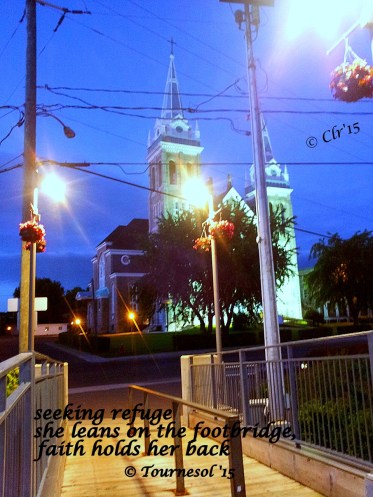
seeking refuge  from despair Haigaseeking refuge
leans over the footbridge,
faith holds her back

And what better way than to use metaphors and with nature they are in abundance…

sur sa pierre tombale
verse des larmes pour son père
le corbeau muet

vent doux souffle
écoute ces paroles d’un être cher
le silence cri

Working fulltime and commuting by public transit, I used moments each day to write what I see and feel. One day I had to stop to remove a stone in my shoe and this is what I saw

(tanka)

Pebble in my show
Queen bee hunts sweet nectar
whilted petals weep
whipped by wind and rain
casualties of nature

When I get off the Métro, I have to walk a short distance and a

(c) Tournesol ’15

Written in response to http://chevrefeuillescarpediem.blogspot.it/2015/06/carpe-diem-utabukuro-3-how-it-all.html

morning glow (haiku)

lovers sleeping,
woodpecker knocks at dawn
playing peekaboo
~
playing peekaboo
golden rays trickle,
morning nudge

© Tournesol ’15

Carpe Diem Summer Morning

a place among pine trees (haibun)

The family would pile in the Chevrolet Impala and drive up the windy roads to Old Orchard, Maine. She loved camping in that pine forest despite sweeping the tent twice a day (or more!) of those dried up pine needles.

The only thing she could not do which was such a natural part of her being, was walking barefoot on that bed of pine needles.  She could walk on gravel and dirt roads but never on that blanket of prickly pine needles.

Their father would leave the girls and their mother for a week while he drove up further to PA on a business trip. Those were the best of times…just the girls, relaxing. Rising only when the sun warmed the tent; toasting bread on the fire and then walking a mile down that shady road surrounded by old wooden cottages and pine trees…so many gigantic pine trees leading up to the beach where they listened to the sounds of rolling waves, seagulls and youngsters giggling…except of course for the odd melodies on their transistor radio…

Salt water beckons
scent of pine interrupted
seagulls greet

© Tournesol ’15

le prunier très cher/ the prized plum tree (haibun)

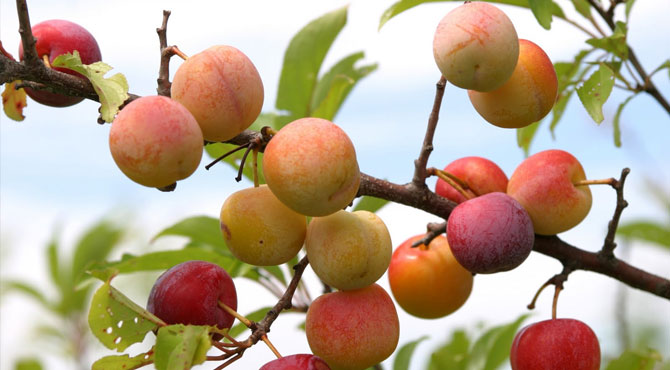
Credits: Japanese Plums

Retour sur la piste de Basho Encore” qui a écrit le haïku suivant peu après la mort soudaine de son ami, Yoshitada.

furu oto ya mimi mo su-naru ume no ame

un son tombant
aigrir mes oreilles
la pluie des prunes

© Basho (Clr traduit de la traduction anglaise par Jane Reichhold)

le prunier très cher

Mon beau-père est décédé mardi. Ce haïbun est écris dans le souvenir de monsieur Bernard. Le haïku de Matsuo Basho m’a rappelé de bon souvenirs de ce grand homme.

Je n’ai jamais vu un prunier avant celui qui était dans la cour de monsieur Bernard (grand-père de nos enfants) quand j’avais à peine seize ans et la fiancée de son fils. Je me souviens de l’arbre qui était grand et maigrichon ; nous avons ri et l’avons tous taquiné à combien d’années qu’il faudra pour enfin voir des fruits ;  mais nous avions tort. En quelques années, l’arbre a fleuri et a porté ses fruits.

Il était si fier de son prunier. Cela signifiait plus qu’un arbre pour lui. Ce fut sa première nouvelle maison dont qu’il et son épouse avaient réussi à gratter et économisez pour loger leurs trois enfants adolescents. Leur fils aîné avait déjà deux petits enfants. Maintenant, ils avaient la liberté d’une grande espace verte avec une petite clairière au fond de la cour. Ils avaient lutté pendant de nombreuses années et maintenant ils avaient humble jardin, quelques arbres et une maison pour appeler «le leur».  C’était une grande victoire.

douce éclat
whoosh sur les brins d’
herbe
première goutte de prune

© Tournesol ‘15

 &&&&&&&&&&&&&&&&&&&&&&&&

“Back on the trail of Basho Encore” who wrote the following haiku shortly after the sudden death of his friend, Yoshitada.

furu oto ya mimi mo su-naru ume no ame
a falling sound

that sours my ears
plum rain © Basho (Tr. Jane Reichhold)

 the prized plum tree

My father-in-law and the grandfather of our children, died on Tuesday. This haibun is in memory of monsieur Bernard. Basho’s haiku reminded me of this great man.

The first plum tree I ever saw was in his back yard when I was barely sixteen, engaged to his son. I remember how tall and scrawny the tree looked and we all chuckled and teased him at how many years it would take to see any fruit but we were wrong. In just a few years, the tree blossomed and bore fruit.

He was so proud of his plum tree. It meant more than a tree to him. This was his first new house his wife and he had managed to scrape and save to own and house their three adolescent children. Their eldest son had already two small children. Now they had the freedom of a huge backyard with a wooded area beyond the property. They had struggled for many years so a humble garden, a few trees and a home to call “theirs” was a huge victory.

soft thump
swish on blades of grass
first plum drop

© Tournesol ’15

Carpe Diem, on the trial with Basho Encore


Daydream-Take: one million and two (haibun)

© Clr `15

Where would she be without her daydreams? If it were not for reading and tapping on that keyboard from time to time, she  might go through most of her days living  in her head. Walking stirs such reveries! Driving or sitting on a bus or train opens doors to another world; watching the sun set or sitting in class to a boring lecture…lying in bed the daydreams simply roll on a neverending  reel.

 Reserved seating
dreams of castles in the air
eyelids screen

© Tournesol ’15

Carpe Diem Day Dreaming

in gratitude (haiga)

summer bracken
the shape of the spots
on the resting fawn

wild rivers
the joy unfurls
in ferns
© Jane Reichhold

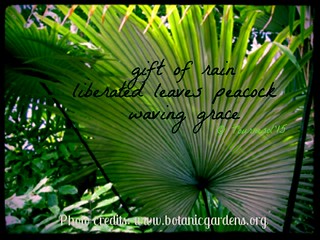
Photo credits: Taken from http://www.botanicgardens.org/our-gardens/york-street/plant-collections/tropical-plant-collection

Photo credits: Tropical Collection – Denver Botanic Gardens

gift of rain
 liberated leaves peacock
waving grace

© Tournesol`15

fragile beauty
through leaves of ferns
I see the sun

© Chèvrefeuille

torn ferns
I use their leaves like a fan
Ah! that coolness

© Chèvrefeuille

echoes of summer (haiku)

© Clr '15
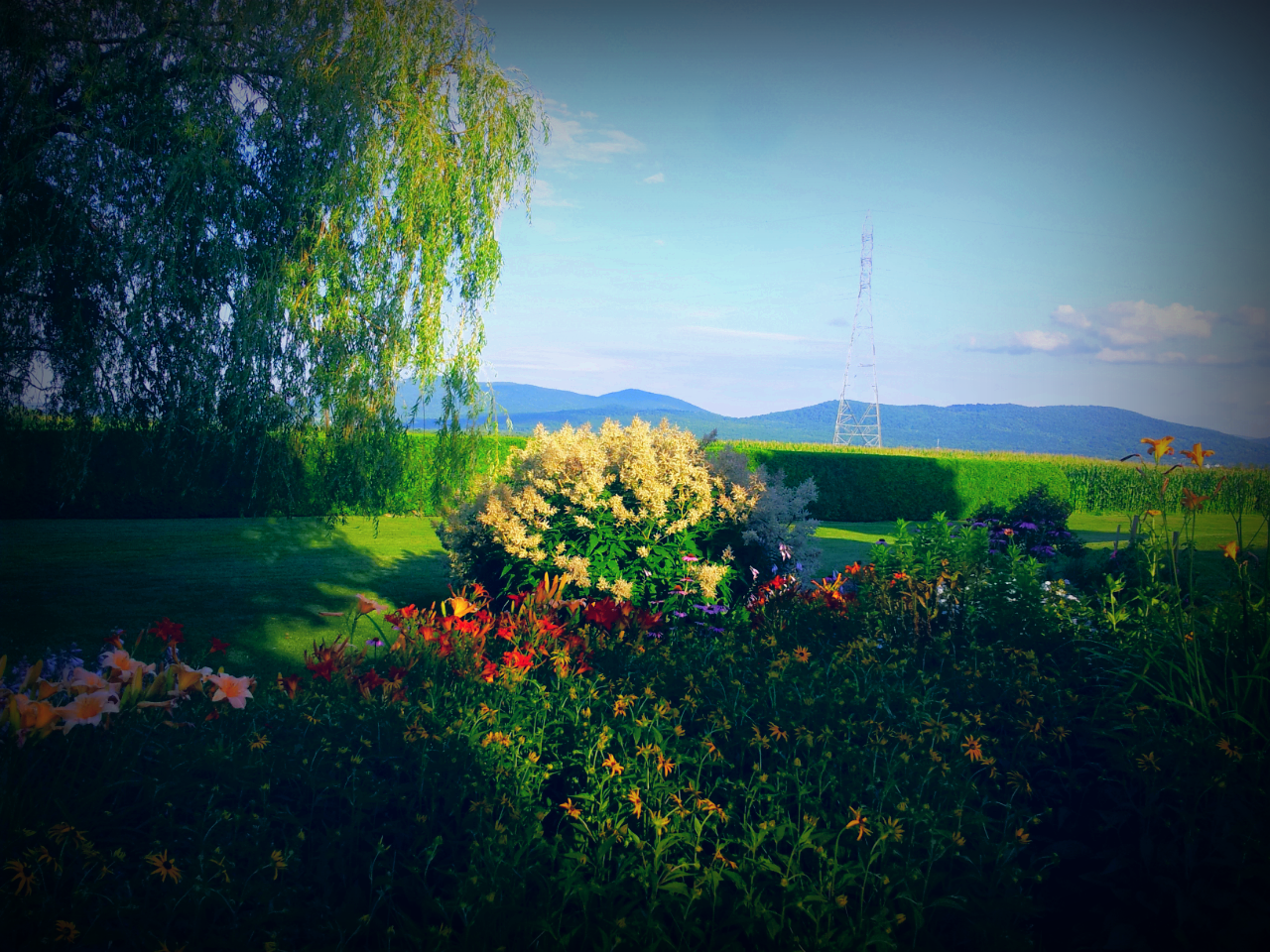
© Clr ’15 Chez Lanoue,  Bromont, Québec


floral carnival,
swell of the willow drapes
nature’s secret

summer reels
giggling youngsters play leap-frog
mountains’ faint echo

© Tournesol’15

Carpe Diem Summer Passing

HaikuHorizons Secret