cherished droplets (haibun)

@ Danimatie – Deviantart “Raindrops in the water”

Walking home after school in spring, she drags her feet singing “Cherish” under her breath. The sun was still shining but a few clouds started moving overhead slowly. She hardly noticed droplets on her chin. Looking up she smiles, knowing somewhere there will be a rainbow.

dancing softly
tiny puddles on the river
raindrops

~
warm droplets
kiss her eyelashes
sun winks

© Tournesol ’15

spring bath (haiga)

© wunderground

chirping

communal bath

mud puddle

© Tournesol ’15

Carpe Diem “Puddles”

flower power (haiga)

hippy love
Pinterest – Hippy Love

chasing playfully
in the open meadow
tag you’re it!

giggling like children
old shed in the meadow
playing naughty

© Tournesol’15

Carpe Diem “Meadow”

lost (Haiga – Freestyle haiku)

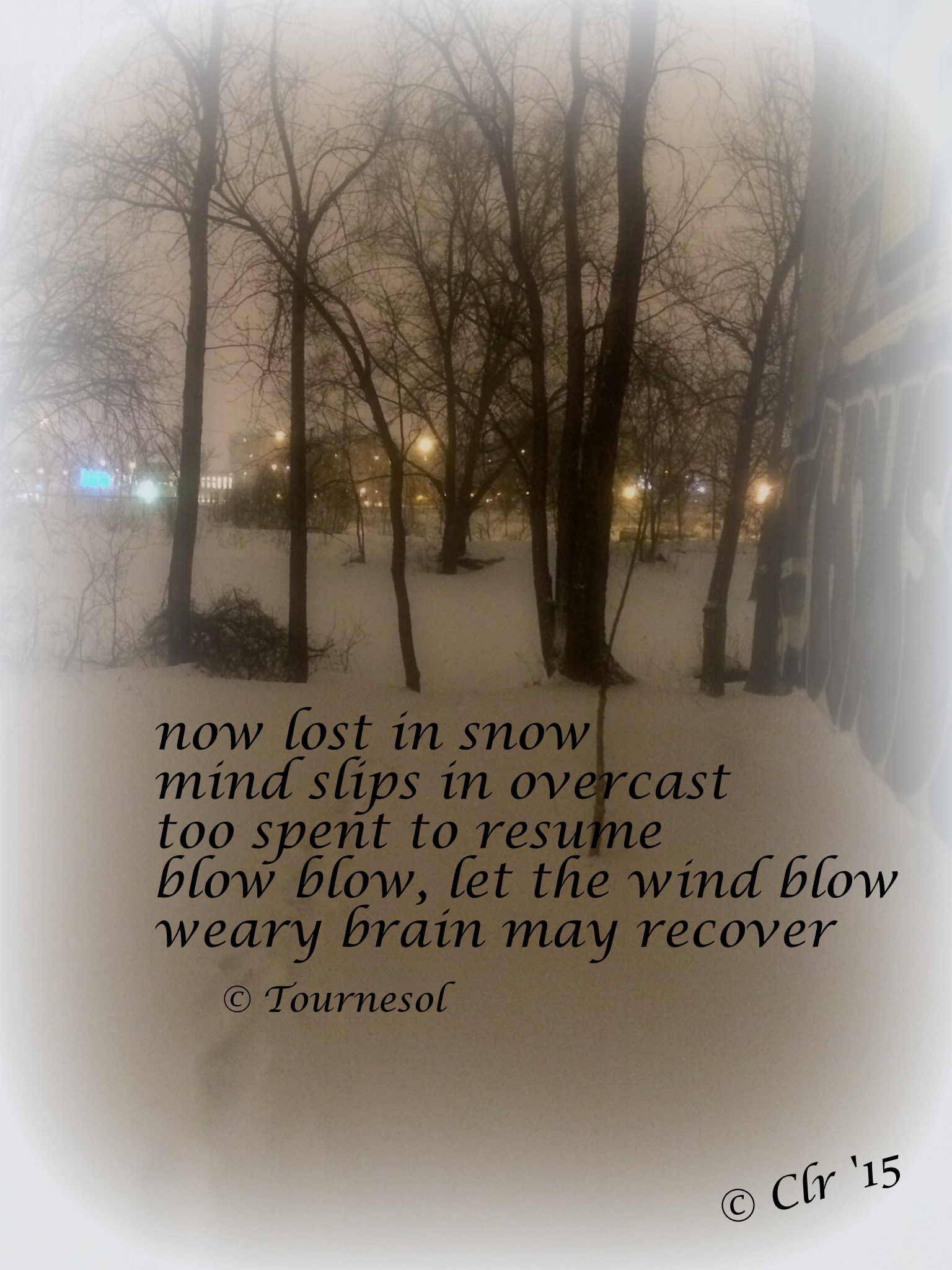
I feel a bit silly after writing my love of spring weather and embracing that “feel good” ambiance on my way to work this afternoon…hence the tanka, Love is in the air.  As I stepped out tonight to come home at  22:00, this is what I saw…I felt like writing a poem starting with SNOW is a 4-letter word but decided to turn this into an opportunity and write a more thought-provoking “free style” haiku for this haiga festival.


March 3rd Snowfall leaving work


March 3rd Snow fall haiga first part corrected

March 3rd Snow fall haiga second part


scribbles a haiku
sunnyside of sidewalk
now lost in snow

 ~

now lost in snow
mind slips in overcast
too spent to resume
blow blow, let the wind blow
weary brain may recover

© Tournesol ’15

Carpe Diem Writing Technique Freestyle Haiku

Love is in the air (haiga)

© Clr ’15

(tanka)

radiant sunshine
snowbanks shrink
city streets are grey
March winds blow debris
love is in the air.


© Tournesol ’15

Free style Haiku Carpe Diem

Last light (haiga)

The days are finally longer and at my first break at 17:30 today, I  got a glimpse of the sun setting. Such a long winter of dark days and only snow to show brightness, this was a treat for me…a sign of new beginnings…

picmonkey_image

sun’s eclipse
ball of fire in the sky
last show of light

© Tournesol ’15

Carpe Diem Haiga Festival (light)

A mother’s delight (haibun)

When I think of the word “Happiness”my memory captures a moment of delight…bliss, such as the photo of my children together. Whether they are 3 or 33, my heart bursts at the seams when I see them just hanging out.  It is a moment in time, a mother has been blessed seeing the evidence of pure joy…her children.

mother venerates
purity of children
moment of grace

© Tournesol ’15


© Clr'15 Tournesol
© Clr’15 Tournesol


Written for Carpe Diem Haiku Kai – Happiness

Verger Ozias Leduc (haiga)

OZIAS LEDUC: PEINTRE SYMBOLISTE

Ozias Leduc was a self-taught painter and his father owned an apple orchard in Mont St Hilaire (south shore of Montreal)

family fun day
au Verger Ozias Leduc
children on tip toes

children on tip toes
apple slips and falls
toddler’s prize

(c) Tournesol ’15


Verger familial C.R.
Verger Familiale – Magog, Québec

toddler’s prize
trying to bite through the skin
worm wiggles out

worm wiggles out
toddler giggles but Mom screams
swallow wins a lunch

(c) Tournesol ’15


Verger Duhaime... Naturellement! - Savour an apple
Verger Duhaime, Québec.

Carpe Diem Haiku Kai The Orchard

Retrouvaille (haibun)


Van Gogh Farms near Auvers

At Carpe Diem we are given a beautiful painting by Van Gogh where the artist spent his last years. Our host, Chèvrefeuille chose House of Auvers for our inspiration to write a haiku. It is an image that one can relate to in many ways.  See more information at Carpe Diem – House (au Auvers)


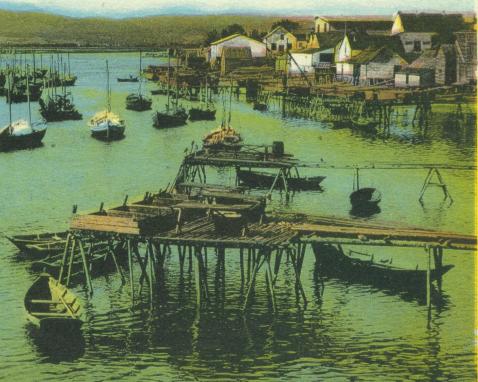
Property of A Canadian Family: Vintage Postcard Collection – Old Gaspé Village

Since the industrial revolution, so many “home visits” have been postponed until spring or summertime. In many parts here in the Montreal area and suburbs,  that is mainly due to the weather and icy roads. I used to work for a steel company who gave their employees a 4-day weekend at Easter so many could drive down to Gaspé for instance,  to visit their family; most of these families had moved here for work but their hearts were still back home.

village réanimé  
retrouvaille familiale
cries des goélands

***

emerging village
family reunions
gulls shriek

© Tournesol ’15

Carpe Diem Haiku Writing Techniques #8, Karumi (Lightness)

Our host and Haiku mentor/master, Chèvrefeuille, prepares haiku prompts daily and sometimes three times in one day. The prompts are not just a word or sentence but also history of Haiku as well he spoon feeds us writing techniques.  I started off a year ago writing 17 syllables not really putting too much meaning into the form and have learned so much since then.  Check on the link below to see what he is teaching us today...Tournesol.

Carpe Diem Haiku Writing Techniques #8, Karumi (Lightness)

“Dear Haijin, visitors and travelers,

It’s Wednesday again and it’s time for a new episode of our Haiku Writing Techniques. This week I love to tell you more about one of the most delightful concepts of haiku writing, Karumi (or Lightness). The concept of Karumi isn’t a new idea, it comes from the other Japanese arts and Basho has tried to bring that Karumi concept into haiku writing in the, say, last ten years of his life.

Not so long ago I got a gift from Jane Reichhold, a copy of her book “Basho, the complete haiku”. You all will understand that I started immediately with reading it, after all (as you all know) I see Basho as my haiku-master.
Jane has put a lot of effort in this book, more than ten (10) years, and of course I was excited and anxious to learn all the wonderful haiku by Basho.
Basho has meant a lot for haiku. He created several new ideas and writing techniques and was really a master of haiku. During his life Basho became in a way a Zen-Buddhist (he studied under Butcho, a Zen Buddhist monk), however he was never really a monk, only during his journeys.
In his time the Japanese roads weren’t great, sometimes only small paths and travelers often were robbed  along the way. The most travelers chose to travel like a monk or priest, because that provided them free and save passage. Basho also traveled like a monk or priest, clothed in a black robe and a shaved head.

Matsuo Basho (1644-1694)

Basho had a big group of disciples and followers close around him, but also widely spread over Japan.
Basho, the traveling poet (he undertook his journeys almost all in the last ten years of his life), had one goal in his last years. He was anxious to spread his idea, his concept, of Karumi (Lightness) in haiku….”  reach more here