The preacher and his wife, had been married fifteen years. Time had become their enemy until finally they were blessed with their first and only child. They were so grateful they named their cherubic daughter, Grace. She was a kind and docile child who sang like a bird. As young as four, she would sit in the garden in their backyard chanting. Sunflowers and daisies had become her audience along with stray cats, squirrels, birds and even insects.
I waited for both children to be in school before making some life changes. I started to volunteer making friendship visits to isolated or terminally ill residents in my community; there was one eighty-eight year old widow, Mrs.Darby who used to teach at my children’s school. She was frail suffering from Emphysema and lonely. One day she called me to get her a loaf of bread. When I arrived at her home with the bread, her next door neighbour was just leaving her home having also dropped off a litre of milk. I chuckled at how cunning she was to insure a visit.
She was a delightful lady. We would spend hours talking about how she used to personally sew her Grade 2 students’ outfits for concerts; one evening we spent hours looking over her Christmas baking recipes. Hearing her talk about her years teaching gave me the idea to invite her to my children’s Christmas recital. There was a snowstorm that day, but we still managed to get to the school. I watched her face glow when she saw the children performing on stage. After the assembly, it was such a treat to see so parents and even some grandparents walk up to greet their former Grade 2 teacher. It was priceless to see the joy on Mrs. Darby’s face…
happenstance
together on the same path
for a season,
a last farewell gift
before finding the light
Getting on to the bus, she shuffled with her cane and asked the young man behind the bus driver for his seat. It is a seat designated for visually impaired or those with limited movement. She would have taken a seat further but her backpack was heavy and there is a shelf to place bags next to that seat. The young man had his ear buds on, on and looked at her and barked, “there are plenty of other seats!” with a smug look on his face. She noticed a seat further down so she took her bag off her shoulders and placed it next to the man and shuffled off to another seat. An older woman looked at her with a look of fear in her eyes. Now that really irked her for she felt that some older and more frail men and women felt intimidated by this behaviour.
society rendering vulnerable – exposed
She sat down and took out her beaded bracelet and decided to chant her mantra silently. All the while trying to “let it go”. It was not easy at first for responses like “What would your mother think about your behaviour? Would you treat your grandmother like that?” But then she was thinking he came from a bad place emotionally and was perhaps hurting…maybe angry at the world. After completing her mantra she could gradually feel a sense of relief, she then chanted in her mind a mantra wishing happiness to the world, thinking of this angry, rude young man.
Om, Lokah Samastah Sukhino Bhavantu Om Shanti, Shanti, Shanti
When she stepped off the bus the young man was behind her and had to pause so she could hold on to the side of the bus to avoid stumbling (like she did last year and fell flat on her face). She noticed he had very fashionable and expensive clothes on and shook her head in dismay at his lack of education and consideration for others.
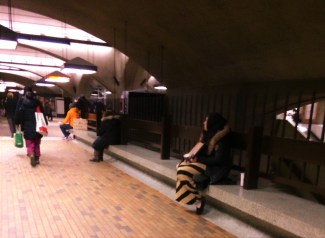
Getting on the Métro, she was saddened looking at the inside of the train…
“May all beings everywhere be happy and free and may the thoughts, words and actions of my own life contribute in some way to that happiness and to that freedom for all.” Shanti: Peace
rendezvous merriment echoes purity of their love savouring stolen moments ‘til they meet again
Every Wednesday, they met behind the gate like clandestine lovers. She would bring a picnic basket and he, a bottle of Merlot. She would often giggle like a young teen despite her sixty years in age. It was the only time she felt alive and filled with a sense of hope until her return home to care for her senile brother.
wind blows in her hair blossoms fall softly on her cheek from the plum tree
She had spent a lazy weekend resting and soaking in tranquil solitude. Her son dropped by briefly unexpectedly. It was a pleasant surprise. It seemed to re-energize her and she later took the time to prepare her dinner with Indian spices and lots of vegetables spread over a bed of quinoa.
I have always felt that we start in life being more visual or more auditory and eventually we become audiovisual. I found that so interesting with my children. My son started off as auditory and my daughter visual. And even if we seem to adapt in an audiovisual world, there are traits, I feel that are still predominant.
I did the test for fun and my results were Visual 31, Audio 43 and Kinesthetic 43 I was pleased to see the visual was as high as it was. In writing haiku, I sometimes struggle to find the words to express what I am seeing for I see with most of my senses. Watching a sunset seems to lower my heartbeat and yet my heart feels so filled with awe. Sitting by the river, the sounds of the current, the birds, the rustle of the leaves and seeing the white caps of the rapids can all be captured in one glance.
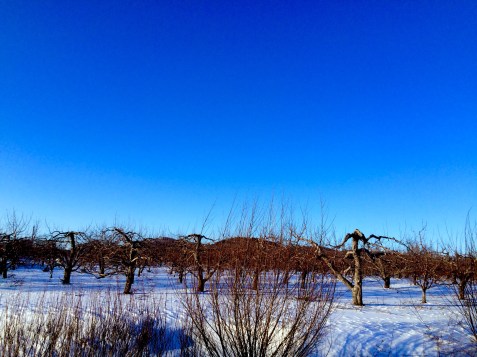
Walking in the arctic cold last weekend I wanted to see the mountainin Rougemont before the sun set. I managed to find a trail behind the local library and was able to take only a few photos before the bitter cold made my battery die.
In the past few years I have been decluttering my home. I have started to give away cherished items to my children and will be giving them more this spring. My son asked me a few years ago if I was dying as he could not understand why I was doing this so soon in my life. I think this purging is symbolic of freeing myself so I can concentrate on things I love like reading, writing and making more time to volunteer and perhaps travel, something I put on hold for many years.
thinking about death gives life meaning
Our host, Chèvrefeuille says, “We all know that we will die someday. We also know that when this will happen we do not know, or what will be happening. Most of us don’t want to think about dying and in a way we hide for it. As I stated in an earlier post … “death is part of life, it’s the only certainty we have”.”
Here is his response:
Death is in my opinion part of life, without thinking about death we cannot live our life, or even better … without thinking about death we can not celebrate life. Look around you enjoy nature, enjoy the coming and going of the seasons in which life and death are each other’s best friends. If you look at living and dying as being part of nature, part of being human … than death can be giving meaning to life.
in the backyard
the old Sakura has lost his blossom
until next spring
She wondered where they all went. Some believe in heaven, purgatory and hell. Yet what if the first few moments after a death there is a limbo where spirits linger for their loved ones…stick around for as long as needed? What if there is a dimension invisible to the human eye except for those who have reached enlightenment?
Where will I be? Will I be in limbo a long time, passing through waiting in between?
Reincarnation is one of the central ideas of Tibetan Buddhism and The Tibetan Book of Living and Dying. I hope to explain this (with the help of Soygal of course).
Rinpoche makes a difference between our “ego”, our daily personality, our “I”, the form / shape our psyche has in our body in which we live our life, and the deeper, natural consciousness, which is our essence.
What happens when we die? In fact only our body dies, but our consciousness “rises” to another new state of being, another dimension maybe. That is our rigpa, the absolute nature of mind (spirit), the consciousness before thoughts and emotions occur / rise. Later it will be reborn in another body.
Death is not the absolute end. Our body doesn’t exist anymore, but our consciousness travels on. The idea of dying can be paralyzing, but in this vision death is just a moment of transition. That makes the idea of death lighter: we are travelers, continuous on our way from one world to another.
Our host’s response
Finally our consciousness will reach enlightenment, maybe not in this life, but maybe in another life.
ghostly nebulae
covers the old graveyard
cherry blossom blooms
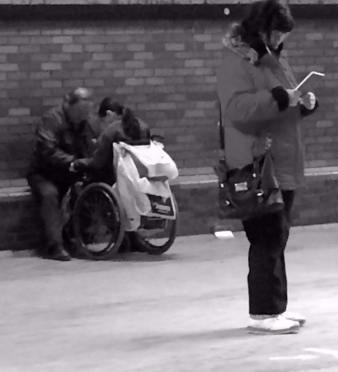
Rushing to work, she couldn’t help but notice the homelessness in the Métro station. Each day at mid-day the same persons are at their “stations”. Another flight down and she reaches the train rails and watches another person getting ready to get set up upstairs next to the convenience store, as she sees every day. The man feeds her discreetly, respectfully, then pushes her wheelchair upstairs for a few hours where she sits…alone, waiting.
The view of fresh fallen snow offers a promise of hope. She looks at the pure whiteness from her bedroom window and smiles. It was a welcoming mild day compared to the arctic weekend she’d just passed…the snow would be heavy yet sticky, just the right consistency to make snow forts, snowballs and snowmen. She saw children giggling and sliding in her mind’s eye.
Walking on the snow-covered sidewalks she noticed the grey skies threatening more snow but it was too mild…surely it may turn to rain or sleet. Mother Nature can get overwhelmed with the earth’s heating; she seemed dazed and confused.
Later shuffling through snow, its texture reminded her of cookie dough batter. You know when you add butter to that fluffy white flour and beat it until it all blends together. Her mind wandered to old childhood memories. Her GrandMaman would let her lick the bowl of batter…how she loved adding just a smidgen of sugar on the raw dough.
GrandMaman would spread the batter and let her granddaughter choose the cookie cutters of shapes of animals, stars or hearts depending on the occasion. Her favourites were the star and heart.
Walking along the street streets, she looked up at the grey skies








 Tournesol dans un Jardin
