lost in thought (haibun)

She frowns at her sunlit streaked window from a long winter’s grime.   Stepping outside she feels the sun’s glow but, still too cool to make the windows squeal like giddy children.

In the meantime, she has plenty of work to do inside.  She grabs a broom and eyes the corners of the ceiling in each room.  The thought of uninvited guests make her want to scratch.

The front entrance is the next move.  She unlocks the door and peaks to see if a neighbour is in the hallway before she steps out in her tattered old hoodie and black leggings.

lost in thought
broom raised automically
a dead fly falls
woven threads rip apart
spider – nowhere to be found


© Tournesol ‘16/03/22


The Secret Keeper 5 word prompt: web, lost, black, scratch, lock


(120 words)

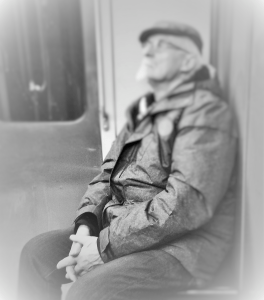
rush hour ride ~ tanka

(c) Clr'16
(c) Clr’16

old man limps
stumbling on the train
head held high
blind to hateful glares
I marvel at his strength

(c) Tournesol 16 – 2 – 26

3 WW ~ limp marvel hateful

earth weeps (tanka)

intense flaws shot
environmental bedlam
out of reach
can’t wait for spring
Mother Nature weeps

© Tournesol ’16/02/26

Written for the prompt at the Secret Keeper: (5) Words: REACH  SHOT INTENSE FLAW  SPRING

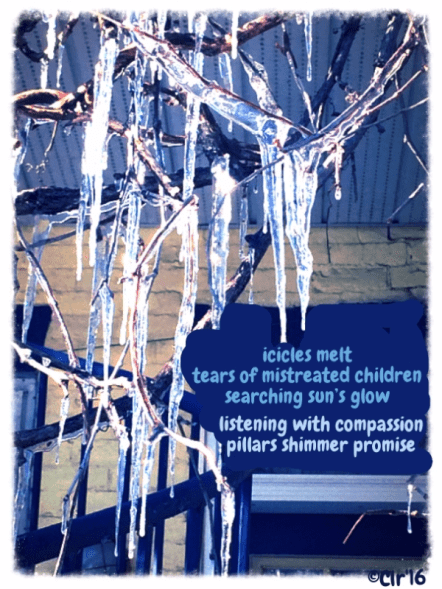
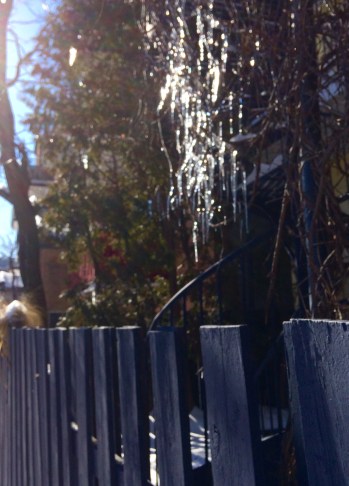
Compassion heals (haiga)

icicles of compassion

icicles melt
tears of mistreated children
searching sun’s glow
listening with compassion
pillars shimmer promise

©Tournesol ’16/02/21

©Clr'16
©Clr’16

Carpe Diem Theme Week #1 episode 5 Tibetan Book of Living and Dying: Insight 4 the power of compassion is limitless

Thinking of death, gives life more meaning (haibun) Episode 4

In the past few years I have been decluttering my home. I have started to give away cherished items to my children and will be giving them more this spring. My son asked me a few years ago if I was dying as he could not understand why I was doing this so soon in my life. I think this purging is symbolic of freeing myself so I can concentrate on things I love like reading, writing and making more time to volunteer and perhaps travel, something I put on hold for many years.

© Clr`16/02/18 Montréal streets

gathering leaves
autumn’s last vibrant breath
ready for winter
misty clouds form icicles
season’s final gems

© Tournesol’16/02/20

Carpe Diem Theme Week #1 episode 4: The Tibetan Book of Living and Dying: Insight 3 “thinking about death gives life meaning”

thinking about death gives life meaning
Our host, Chèvrefeuille says, “We all know that we will die someday. We also know that when this will happen we do not know, or what will be happening. Most of us don’t want to think about dying and in a way we hide for it. As I stated in an earlier post … “death is part of life, it’s the only certainty we have”.”

Here is his response:

Death is in my opinion part of life, without thinking about death we cannot live our life, or even better … without thinking about death we can not celebrate life. Look around you enjoy nature, enjoy the coming and going of the seasons in which life and death are each other’s best friends. If you look at living and dying as being part of nature, part of being human … than death can be giving meaning to life.

in the backyard
the old Sakura has lost his blossom
until next spring

© Chèvrefeuille

slipping (tanka) “through the chinks comes the light”

rocking gently
sinks in a deep slumber
lull of the water
between sudden arrests
slips in the shimmering abyss

© Tournesol’16/02/19

Carpe Diem Theme Week #1 episode 3 The Tibetan Book of Living and Dying Insight 2 “through the chinks comes the light”

What happens exactly as you die? In the Tibetan Book of Living and Dying Sogyal Rinpoche explains it through the idea/ thought of bardo. “Bardo” means “inbetween” and its a kind of transition-mode. Let us look further in the depth of the meaning of bardo, maybe than we can understand it 100%.

Through the chinks comes the light

The original meaning of bardo is, the space between the moment of dying and reincarnation / rebirth. As we ‘dive’ deeper into this matter than we discover more than one bardo. Let’s go …

First there is the bardo of living and dying. This is a painful bardo, but also the moment that the nature of spirit / soul becomes real and in a way breaks through the armor of the body. This we can see in, for example, the story of Easter as Jesus prays in the Garden of Gethsemane and asks His Father, God, to take away the cup of poison. Than He is arrested and indures the pain of 39 lashes and the crucifixion. As He dies He commands His Spirit to His Father. This is what we can call the bardo of living and dying.

 What follows is the bardo which is called the shining bardo or dharmata, the state of consciousness / mind after death. To explain this shining bardo, wasn’t easy, because I could not find something to explain it with. Than I got a revelation. This shining bardo you can see as a bright light, the radiation of the pure nature of spirit / mind. It’s a state of pure happiness. In a way this you can see as what is happening as you (someone) has a Near Death Experience (NDE). I ran into a few stories about NDE when I was preparing these episodes. As you read the reports about NDE than everyone sees a bright light in which shadows are moving, ancestors mostly, but angels too.
This shining bardo doesn’t stay forever. Sometimes it takes / endures seven days, but it can also take seven weeks.

The next bardo is called the bardo of becoming. The consciousness / mind finds a new place, in a new body and a new life gets started. This we can also see in the story of Easter. After three days, and taht’s very fast as we compare this with the Tibetan idea about living and dying, Jesus rises from the grave. He conquered dead and became an enlightened being who walks a short time on this earth and than rises to Heaven making the Holy Spirit, a kind of reborn energy, avalable to the world. With His ressurection and entering Heaven He broke the Circle of Bardo, as did Buddha.

In Tibetan tradition of bardo the songs from The Book of the Dead were recited by the monks to lead the spirit. Rinpoche goes further in this idea and describes his ideas in The Tibetan Book of Living and Dying. In his book he sees life as it is as a bardo. The bardo between birth and the moment of sying, life in itself is a transition. It’s a time in which we learn, contemplate, meditate and prepare on death.

Rinpoche goes even further, a period of uncertainty can also be a bardo. For example, the moment you come home and see that there has been a burglary while you were away. Or that moment between “I have bad news” and “I have to tell you …” At that moment the concrete of your reality breaks and you feel that the ground is disappearing beneath your feet. Than the realization comes … you see the essence. No more time for futilities. It’s a moment of truth … you can see what really is important.

This is what this Insight means … discover the truth by tearing down the veil. This is what happened as Jesus died at the cross. The veil that hid the Holy of Holies was torn apart exposing the holiest place in the temple and the revelation that Jesus really was the Son of God.

Our host’s  response

To write a haiku, tanka or another Japanese poetry form about this 2nd Insight isn’t easy I think, but I had to try it myself (of course) and this is what came in mind, a haiku from my archives:

phoenix spreads its wings
after the dark cold winter night
finally spring

© Chèvrefeuille

Daily Moments Feb 18 ~ Happy Birthday Georgia! (tanka ~ haiku)

© clr'16
© clr’16

across the ocean
she writes at early dawn
I’m up at twilight
savouring her morning waka
my bedtime reading

tonight at midnight
wishing her a Happy Birthday
sending her cyber-hugs

un souhait sincère
une journée insolée
bonne fête, Cara!

© Tournesol ’16/02/18

Daily Moments ~ Feb 18 2016

Happy Birthday Georgia at Bastetandsekhmet 

view from the top (tanka)

catching a view
that age old promise
walkin’ the beat
trying to reach the top
…just keep on walkin’

(c) Tournesol’16-02-17

Written for The Secret Keeper’s prompt: view walk promise beat old

Inspired by a poem I wrote earlier in free verse

Walk don t run free verse on meditative reflections Free Verse

walk
take your time
walk
do not climb

walk
do not run
breath in
breath out

walk
take your time
don’t beat
the clock
reaching for the top

walk
take your time
in the end
you will
get a view
crossing over

walk
take your time
breath in
breath out

seeking,
longing
that aged old promise
everlasting life

walk
take your time
breath in
breath out.

(c) Cheryl-Lynn  2016-02-17

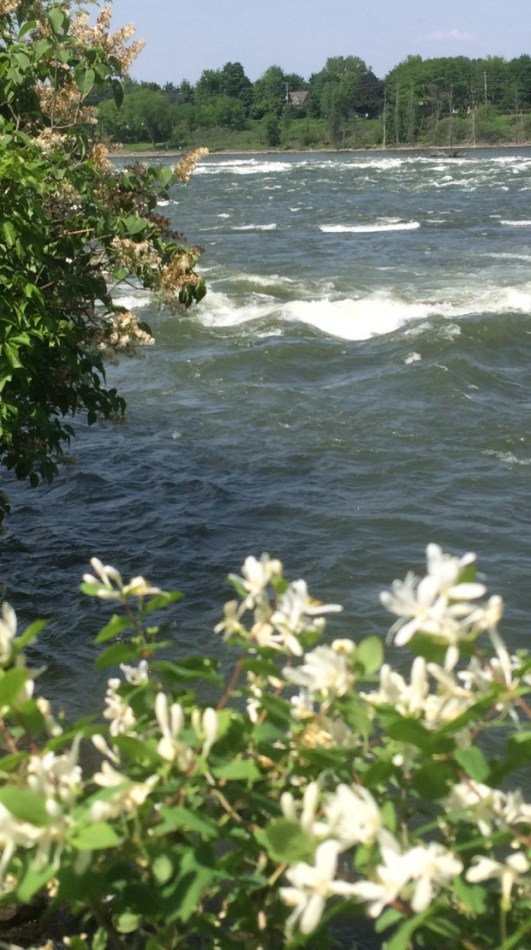
liquid secrets (tanka – haiku)

© Clr'15 Rivière Richelieu, Chambly, Qc.
© Clr’15 Rivière Richelieu, Chambly, Qc.

(tanka)

staring at the waves
rolling on the river
taking hold of me
dripping true emotions
no longer wear me down.

(haiku)

river holds
roaring white rapids –
all my secrets

(c) Tournesol ’16

The Secret Keeper

| STARE | RIVER | HOLD | TRUE | WEAR |

Passion’s touch (tanka)

winter wind whistles
frosted windows peak
lovers spooning
warmth of their flesh rises
under down filled duvet

(c) Tournesol’16

Carpe Diem “touch”