I waited for both children to be in school before making some life changes. I started to volunteer making friendship visits to isolated or terminally ill residents in my community; there was one eighty-eight year old widow, Mrs.Darby who used to teach at my children’s school. She was frail suffering from Emphysema and lonely. One day she called me to get her a loaf of bread. When I arrived at her home with the bread, her next door neighbour was just leaving her home having also dropped off a litre of milk. I chuckled at how cunning she was to insure a visit.
She was a delightful lady. We would spend hours talking about how she used to personally sew her Grade 2 students’ outfits for concerts; one evening we spent hours looking over her Christmas baking recipes. Hearing her talk about her years teaching gave me the idea to invite her to my children’s Christmas recital. There was a snowstorm that day, but we still managed to get to the school. I watched her face glow when she saw the children performing on stage. After the assembly, it was such a treat to see so parents and even some grandparents walk up to greet their former Grade 2 teacher. It was priceless to see the joy on Mrs. Darby’s face…
happenstance
together on the same path
for a season,
a last farewell gift
before finding the light
Our host has presented an interesting prompt as we discuss episode 7: The Tibetan Book of Living and Dying Insight 6 balance isn’t always necessary and his introduction on this subject speaks to me as well as his haiku.
Working on a youth line, listening to youths in crisis every evening, I have to find some balance in my life so I do not live with stories of abuse and sadness. Reading was my way to escape for many years until I rediscovered writing. I am able to defuse pent up emotions and other times rediscover the beauty around me and write about it in a haibun, haiku, troiku or tanka. In other words, waka has added the beauty of nature dripping in my whole being with sights, sounds and scents.
I take away so much strength from the power of the firmament…the blues, the greys, the curves of clouds as well as sunsets I often view on my break on the rooftop at work.
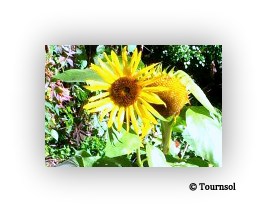
Our host has written a haiku about early dawn which is a time I rarely see at the start of my day recently due to my shift change in the past few years but I do remember that spiritual feeling The haiku includes a sunflower which is my nom de plume in French, Tournesol, so his haiku truly speaks to me. …here is my response to his haiku I have composed in a Troiku which is a haiku form created by our host, Chèvrefeuille.
in the light of dawn sunflowers reach to the blue sky praising their Creator
Rinpoche sees life as a bardo (a kind of transition station) and that’s not a such bad idea in my opinion. It shows us that our consciousness has senses, lives in a world, observes, starts relationships, living life. Rinpoche says: “Life is to discover the goodness of life, an exercise to realize that life is good and that also means … accepting dead as part of our life.”
Look at yourself with compassion from the depth of your consciousness, your soul. It’s a peaceful thought to know that our daily personality has a deeper Inner Self to whom we can listen always. Our Inner Self is our tower of strength. A lovely Inner Voice, that whispers: “Yes you are out of balance, but don’t worry you will regain your balance. You need this difficult time to grow and become stronger and more balanced. So don’t worry, don’t be afraid, I am there, I am with you. I travel with you”. Isn’t that a reassured idea? Isn’t that the reason to live your life to the fullest?
My response
This is so true. Whenever I find myself out of balance, my body breaks down and I need to take time off and rest. Often these were times I discovered the value of true friends who were there to take walks in nature, share a home cooked meal or just listen and be present with me. I also love long moments alone…
What happens exactly as you die? In the Tibetan Book of Living and Dying Sogyal Rinpoche explains it through the idea/ thought of bardo. “Bardo” means “inbetween” and its a kind of transition-mode. Let us look further in the depth of the meaning of bardo, maybe than we can understand it 100%.
Through the chinks comes the light
The original meaning of bardo is, the space between the moment of dying and reincarnation / rebirth. As we ‘dive’ deeper into this matter than we discover more than one bardo. Let’s go …
First there is the bardo of living and dying. This is a painful bardo, but also the moment that the nature of spirit / soul becomes real and in a way breaks through the armor of the body. This we can see in, for example, the story of Easter as Jesus prays in the Garden of Gethsemane and asks His Father, God, to take away the cup of poison. Than He is arrested and indures the pain of 39 lashes and the crucifixion. As He dies He commands His Spirit to His Father. This is what we can call the bardo of living and dying.
What follows is the bardo which is called the shining bardo or dharmata, the state of consciousness / mind after death. To explain this shining bardo, wasn’t easy, because I could not find something to explain it with. Than I got a revelation. This shining bardo you can see as a bright light, the radiation of the pure nature of spirit / mind. It’s a state of pure happiness. In a way this you can see as what is happening as you (someone) has a Near Death Experience (NDE). I ran into a few stories about NDE when I was preparing these episodes. As you read the reports about NDE than everyone sees a bright light in which shadows are moving, ancestors mostly, but angels too.
This shining bardo doesn’t stay forever. Sometimes it takes / endures seven days, but it can also take seven weeks.
The next bardo is called the bardo of becoming. The consciousness / mind finds a new place, in a new body and a new life gets started. This we can also see in the story of Easter. After three days, and taht’s very fast as we compare this with the Tibetan idea about living and dying, Jesus rises from the grave. He conquered dead and became an enlightened being who walks a short time on this earth and than rises to Heaven making the Holy Spirit, a kind of reborn energy, avalable to the world. With His ressurection and entering Heaven He broke the Circle of Bardo, as did Buddha.
In Tibetan tradition of bardo the songs from The Book of the Dead were recited by the monks to lead the spirit. Rinpoche goes further in this idea and describes his ideas in The Tibetan Book of Living and Dying. In his book he sees life as it is as a bardo. The bardo between birth and the moment of sying, life in itself is a transition. It’s a time in which we learn, contemplate, meditate and prepare on death.
Rinpoche goes even further, a period of uncertainty can also be a bardo. For example, the moment you come home and see that there has been a burglary while you were away. Or that moment between “I have bad news” and “I have to tell you …” At that moment the concrete of your reality breaks and you feel that the ground is disappearing beneath your feet. Than the realization comes … you see the essence. No more time for futilities. It’s a moment of truth … you can see what really is important.
This is what this Insight means … discover the truth by tearing down the veil. This is what happened as Jesus died at the cross. The veil that hid the Holy of Holies was torn apart exposing the holiest place in the temple and the revelation that Jesus really was the Son of God.
Our host’s response
To write a haiku, tanka or another Japanese poetry form about this 2nd Insight isn’t easy I think, but I had to try it myself (of course) and this is what came in mind, a haiku from my archives:
phoenix spreads its wings
after the dark cold winter night
finally spring
The mgur as a primarily religious genre, dates chiefly from the time of the greatest of all Tibetan poets, Mi la ras pa* (1040-1123). Though his hundreds of mgur were not given their definitive written form until several centuries after his death, their influence on Tibetan culture seems to have been widespread from Mi la’s time onward, through their preservation in various oral versions and written recensions, and through the importance Mi la quickly assumed as a Tibetan Buddhist culture-hero. Mi la’s greatness lay in his ability to compose songs that combined the imagery, structural parallelism and expressive directness of ancient glu with distinctively Buddhist themes and Indian-inspired metrical schemes. In particular, Mi la ras pa—and thus the classical tradition of mgur—can be seen as inheriting two major influences:
(1) the early diffusion traditions of songs of “positive personal experience,” primarily secular in orientation and distinctly Tibetan in style, and
(2) the tradition—brought to Tibet by Mi la’s guru Mar pa—of tantric songs, those often spontaneous, always richly symbolic dohās, caryāgīti or vajragīti sung by Indian mahāsiddhas to express their spiritual realizations.
The themes, moods and styles of Mi la’s mgur range widely: though the Dharma almost always is the real subject, it is expressed in verses at various times simple or complex, devout or wrathful, puritanical or ribald, humorous or stern, intensely autobiographical or impersonally didactic. An example of one of this mgur (songs) composed by Mi la ras pa
Faith is the firm foundation of my house, Diligence forms the high walls, Meditation makes the huge bricks, And Wisdom is the great corner-stone. With these four things I build my castle, And it will last as long as the Truth eternal! Your worldly houses are delusions, Mere prisons for the demons, And so I would abandon and desert them.
The success of Mi la ras pa’s songs in helping to popularize Buddhism, combined with the innate Tibetan love of poetry and song, helped assure that in the centuries after Mi la, mgur composition came to be a widely practiced art.
She wondered where they all went. Some believe in heaven, purgatory and hell. Yet what if the first few moments after a death there is a limbo where spirits linger for their loved ones…stick around for as long as needed? What if there is a dimension invisible to the human eye except for those who have reached enlightenment?
Where will I be? Will I be in limbo a long time, passing through waiting in between?
Reincarnation is one of the central ideas of Tibetan Buddhism and The Tibetan Book of Living and Dying. I hope to explain this (with the help of Soygal of course).
Rinpoche makes a difference between our “ego”, our daily personality, our “I”, the form / shape our psyche has in our body in which we live our life, and the deeper, natural consciousness, which is our essence.
What happens when we die? In fact only our body dies, but our consciousness “rises” to another new state of being, another dimension maybe. That is our rigpa, the absolute nature of mind (spirit), the consciousness before thoughts and emotions occur / rise. Later it will be reborn in another body.
Death is not the absolute end. Our body doesn’t exist anymore, but our consciousness travels on. The idea of dying can be paralyzing, but in this vision death is just a moment of transition. That makes the idea of death lighter: we are travelers, continuous on our way from one world to another.
Our host’s response
Finally our consciousness will reach enlightenment, maybe not in this life, but maybe in another life.
ghostly nebulae
covers the old graveyard
cherry blossom blooms
This flash fiction was prompted by The Carrot Flash Fiction Challenge this week and we were to write about wild open spaces with a bonus if you could add something cute and furry.
The Witching Hour (Flash Fiction 99 words – no more, no less)
It was approaching the witching hour that most parents dread.
“MOMMY! Oli buggin me !” her toddler whined.
Oli snickered, proud he succeeded to put a dent in the mommy-daughter coziness since he arrived from JK.
It was only four-fifteen. She couldn’t take the squeals and whining. She called her next-door neighbour, “Janet, I think I just might lose it.”
Janet let out her warm loving chuckle, “Send them over here and the girls will keep them busy.”
Biking towards the open fields, with each breath, she allowed her frustrations of the day to scatter over the wild daisies. (99 words)
Walking in the soft snow last night, I was reminded of our long winter walks at night, chatting about life and family. We would walk for hours.
Janet was a dear friend who kept me sane when my children were pre-schoolers. She taught me to relax, stop trying to have the perfectly clean and tidy house and just enjoy the children. I am forever grateful to her and her family.
She struggles to be on time at work but for dinners, parties, outings, she is usually late. She prefers to say, fashionably late. Being a night person and working late shifts, means late morning rise, working into the night.
nightly reflections
slow-dancing with her muse
kissing dawn goodnight




 Tournesol dans un Jardin