Chiyo-Ni
In regard to the poem, called “Oh, Morning Glory!”, Hirshfield quotes D. T. Suzuki:
“The idea is this: One summer morning Chiyo the poetess got up early wishing to draw water from the well…She found the bucket entwined by the blooming morning glory vine. She was so struck…that she forgot all about her business and stood before it thoroughly absorbed in contemplation. The only words she could utter were ‘Oh, the morning glory!’ At the time, the poetess was not conscious of herself or of the morning glory as standing against [outside] her. Her mind was filled with the flower, the whole world turned into the flower, she was the flower itself…
“The first line, ‘Oh morning glory!’ does not contain anything intellectual…it is the feeling, pure and simple, and we may interpret it in any way we like. The following two lines, however, determine the nature and depth of what was in the mind of the poetess: when she tells us about going to the neighbor for water we know that she just left the morning glory as she found it…she does not even dare touch the flower, much less pluck it, for in her inmost consciousness there is the feeling that she is perfectly one with reality.
“When beauty is expressed in terms of Buddhism, it is a form of self- enjoyment of the suchness of things. Flowers are flowers, mountains are mountains, I sit here, you stand there, and the world goes on from eternity to eternity, this is the suchness of things.” Taken from WomenMasters
the well –bucket
taken by the morning glory:
I ask for water
© Chiyo-Ni
My humble offering inspired by Chiyo-Ni’s haiku:
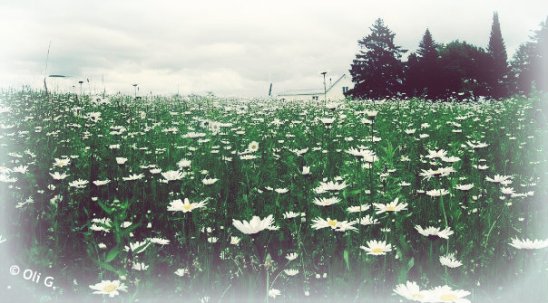
on a bed of daisies
prickly grass no longer,
dandelion puff
dandelion puff
my body
floats
©Tournesol’17/02/21

 Tournesol dans un Jardin
A haiku gentle as a dandelion puff, Cheryl-Lynn!
LikeLiked by 1 person
Thanks, Kim…I sort of got carried away and shrunk into a fairy with this one 😉
LikeLiked by 1 person
🙂
LikeLiked by 1 person
The minimalism of your second haiku works particularly well, and the idea.
Your first haiku is fragranced with your natural sensuality.
LikeLike
I am truly humbled by your comment, Hamish, thank you.
LikeLike
Beautiful story and beautiful interpretation.
LikeLike
Thank you:)
LikeLike
Wow! 🙂
LikeLiked by 1 person
Thanks so much, Celestine! 🙂
LikeLike
It seems like there are more haijin of CDHK that are “caught” by the “free-style” way of haiku-ing as did Santoka Taneda.
LikeLike
I agree, Kristjaan. I often start by abiding by the classic rules as a draft and when I edit, I often ask myself, what is really needed…that’s when I delete some words. However with tanka, I often stick more with the classic rules.
LikeLiked by 1 person
I love ‘to cut the words back’ in my haiku. So maybe I am more influenced by Santoka Taneda than I thought.
LikeLike
I love your haiku and the simplicity of less give that hint of a moment only the reader truly knows but the reader enjoys interpreting…like a painting.
LikeLike